

10 Practical Ways Businesses Can Improve Their ESG Score
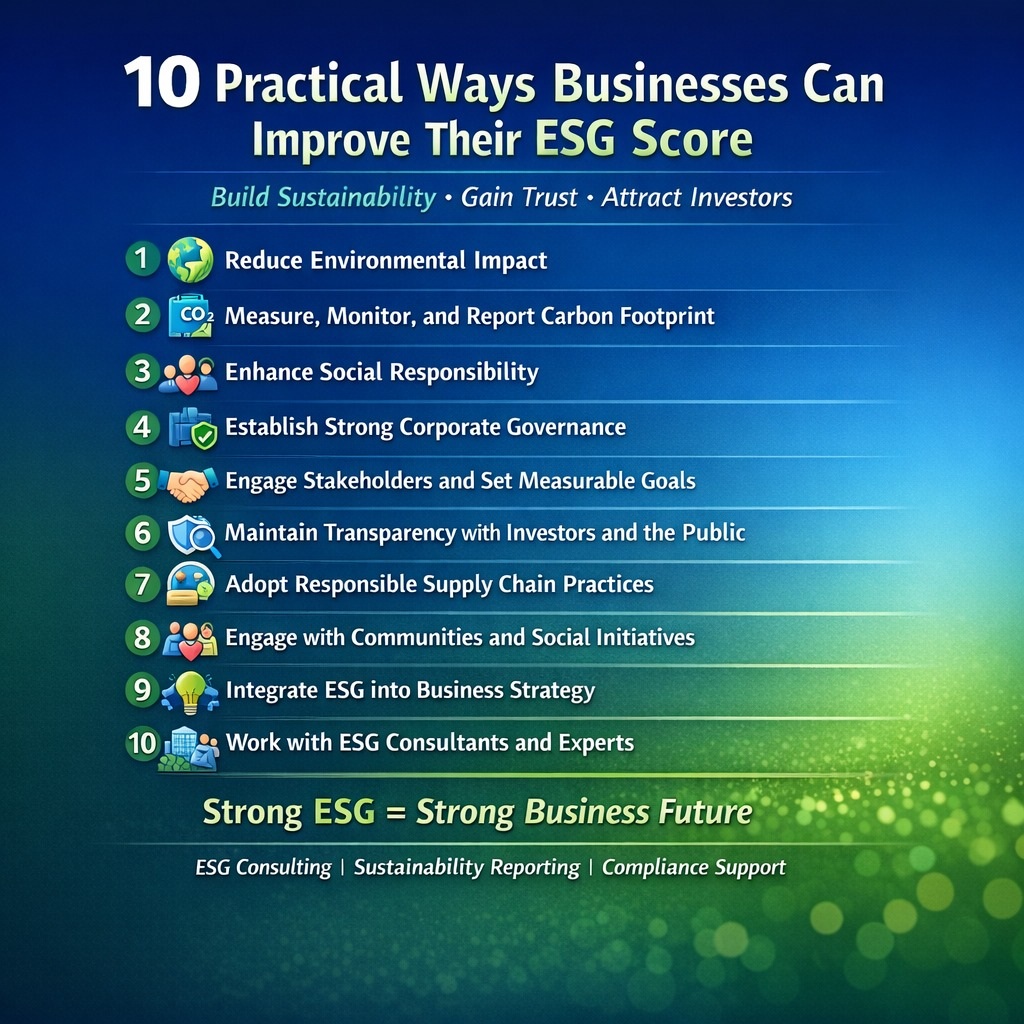
Environmental, Social, and Governance (ESG) performance has become a key indicator of corporate responsibility and long-term business sustainability. Investors, regulators, and customers increasingly evaluate companies based on their ESG performance before making decisions. In regions like the UAE and across global markets, businesses that demonstrate strong ESG practices gain better access to investment, improved brand reputation, and stronger stakeholder trust.
Improving an ESG score does not require a complete transformation overnight. Instead, companies can begin with practical, measurable actions that enhance sustainability, governance, and social responsibility over time. Below are ten practical ways businesses can improve their ESG performance and strengthen their sustainability profile.
1. Reduce Environmental Impact
✅ Implementing green building practices.
✅ Improving energy efficiency by upgrading to efficient HVAC and lighting systems.
✅ Conducting regular energy audits.
✅ Implement a comprehensive waste management program that emphasizes waste reduction, reuse, recycling, and safe disposal of hazardous waste.
✅ Water conservation measures, such as low-flow fixtures, efficient water use practices, and monitoring of water consumption, should also be adopted.
2. Measure, Monitor, and Report Carbon Footprint
✅ Measure and monitor environmental footprint by tracking key indicators such as energy consumption, water usage, and waste generation.
✅ Clear and measurable carbon emission reduction targets should be established in alignment with global sustainability and climate goals.
3. Enhance Social Responsibility
Enhancing social responsibility helps improve ESG performance and strengthens the organization’s reputation.
✅ Companies should promote diversity and inclusion by ensuring equal opportunities for all employees.
✅ Improve labor practices and employee welfare.
✅ Promote and encourage charitable initiatives within your organization.
✅ Invest in community development initiatives that prioritize critical issues, including healthcare, education, and economic development.
4. Establish Strong Corporate Governance
Governance is a crucial pillar of ESG that focuses on ethical leadership, transparency, and accountability.
Businesses can improve governance standards by:
✅ Implementing clear corporate policies
✅ Establishing ethical codes of conduct
✅ Ensuring transparent financial reporting
✅ Strengthening board oversight and compliance systems
Strong governance structures reduce risks, improve decision-making, and increase investor confidence.
5. Engage Stakeholders and Set Measurable Goals
Engaging stakeholders and setting measurable goals are essential for improving ESG performance and ensuring transparency.
✅ Identify key stakeholders such as investors, employees, customers, suppliers, regulators, and local communities, and understand their expectations and concerns.
✅ Develop a structured stakeholder engagement approach, including surveys, meetings, and consultations.
✅ Regularly communicate ESG goals, progress, and performance through sustainability reports, annual reports, and other communication channels.
✅ Stakeholder feedback should be incorporated into ESG strategies
6. Maintain Transparency with Investors and the Public
Maintaining transparency with investors and the public is essential for building trust, accountability, and a strong corporate reputation.
✅ Publish ESG or sustainability reports that clearly outline their environmental, social, and governance initiatives, progress, and future goals.
✅ ESG information should also be shared through multiple communication channels such as company websites, investor presentations, press releases, and social media
✅ Companies should communicate both achievements and challenges openly, demonstrating commitment to continuous improvement.
✅ Ensure that all ESG data is accurate, reliable, and supported by strong data management systems.
✅ Aligning ESG disclosures with recognized frameworks such as GRI, SASB, or TCFD enhances credibility and comparability.
✅ Determine future ESG targets and sustainability strategies.
7. Adopt Responsible Supply Chain Practices
A company’s ESG performance is also influenced by the sustainability practices of its suppliers and partners.
Businesses should ensure that their supply chains follow ethical and environmental standards by:
✅ Evaluating supplier sustainability practices
✅ Choosing environmentally responsible vendors
✅ Ensuring fair labor practices within the supply chain
✅ Monitoring supplier compliance regularly
Responsible supply chain management reduces operational risks and strengthens ESG performance.
8. Engage with Communities and Social Initiatives
Community engagement is an important part of the social dimension of ESG.Companies that contribute positively to society strengthen their reputation and stakeholder relationships.
Examples of community engagement include:
✅ Supporting local charities or social initiatives
✅ Participating in environmental awareness campaigns
✅ Sponsoring educational or community programs
✅ Encouraging employee volunteer programs
These activities demonstrate a company’s commitment to social responsibility and long-term societal impact.
9. Integrate ESG into Business Strategy
Many companies treat ESG as a separate initiative rather than a core business strategy. To truly improve ESG performance, sustainability must be integrated into decision-making and long-term planning.
Businesses should:
✅ Align ESG goals with corporate strategy
✅ Set measurable sustainability targets
✅ Include ESG considerations in investment decisions
✅ Train leadership teams on ESG principles
Embedding ESG into corporate strategy ensures consistent improvement and long-term sustainability.
10. Work with ESG Consultants and Experts
For many organizations, navigating ESG frameworks, regulations, and reporting standards can be complex.Professional ESG consultants can guide companies through the implementation process by providing:
✅ ESG gap analysis and assessments
✅ Sustainability strategy development
✅ ESG reporting frameworks
✅ Regulatory compliance support
✅ Carbon footprint measurement
Working with experienced consultants allows businesses to accelerate ESG implementation and achieve improvements in sustainability performance.
The Long-Term Value of Strong ESG Performance
Improving ESG performance is not only about compliance, but it also creates long-term business value. Companies that prioritize sustainability and ethical governance are better prepared to manage risks, attract investors, and maintain a competitive advantage in the global market.
Strong ESG practices help businesses:
✅ Enhance brand reputation
✅ Improve investor confidence
✅ Reduce environmental impact
✅ Strengthen corporate governance
✅ Build resilient and sustainable operations
As global markets continue to emphasize sustainability, organizations that invest in ESG today will be better positioned for long-term success.