

Carbon Footprint Calculation in UAE: Step-by-Step Guide for Businesses (2026)
As the UAE accelerates its sustainability goals under the Net Zero 2050 strategy, businesses are under increasing pressure to measure and reduce their carbon emissions. Carbon footprint calculation is now a critical part of ESG compliance, investor reporting, and regulatory alignment.
Whether you are a corporate entity, developer, or SME, understanding how to calculate your carbon footprint in the UAE is the first step toward sustainable operations and compliance.
What is a Carbon Footprint?
A carbon footprint is the total amount of greenhouse gases that are generated by our actions. It includes direct emissions, such as those that result fossil fuel combustion in manufacturing, heating, and transportation as well as emissions required to produce the electricity associated with goods and services consumed.
This means: Carbon footprint is the total amount of greenhouse gas (GHG) emissions produced directly and indirectly by a business.
It includes emissions from:
• Emissions produced = Emissions removed or offset
The initiative focuses on:
• Energy consumption
• Transportation
• Industrial processes
• Supply chain activities
These emissions are measured in CO₂ equivalent (CO₂e).
Understanding Scope 1, 2, and 3 Emissions
To calculate your carbon footprint, emissions are categorized into three scopes:
Scope 1 (Direct Emissions)
• Fuel combustion (diesel, gas)
• Company-owned vehicles
Scope 2 (Indirect Energy Emissions)
• Electricity consumption
• Cooling and heating systems
Scope 3 (Value Chain Emissions)
• Supplier emissions
• Business travel
• Waste disposal
Scope 3 is often the largest and most complex category.
Why Carbon Footprint Calculation is Important in UAE
✔ Regulatory Compliance
Aligns with UAE environmental laws and ESG requirements
✔ ESG Reporting
Supports frameworks like GRI, SASB, and TCFD
✔ Cost Reduction
Identifies inefficiencies in energy and resources
✔ Investor Confidence
Demonstrates sustainability commitment
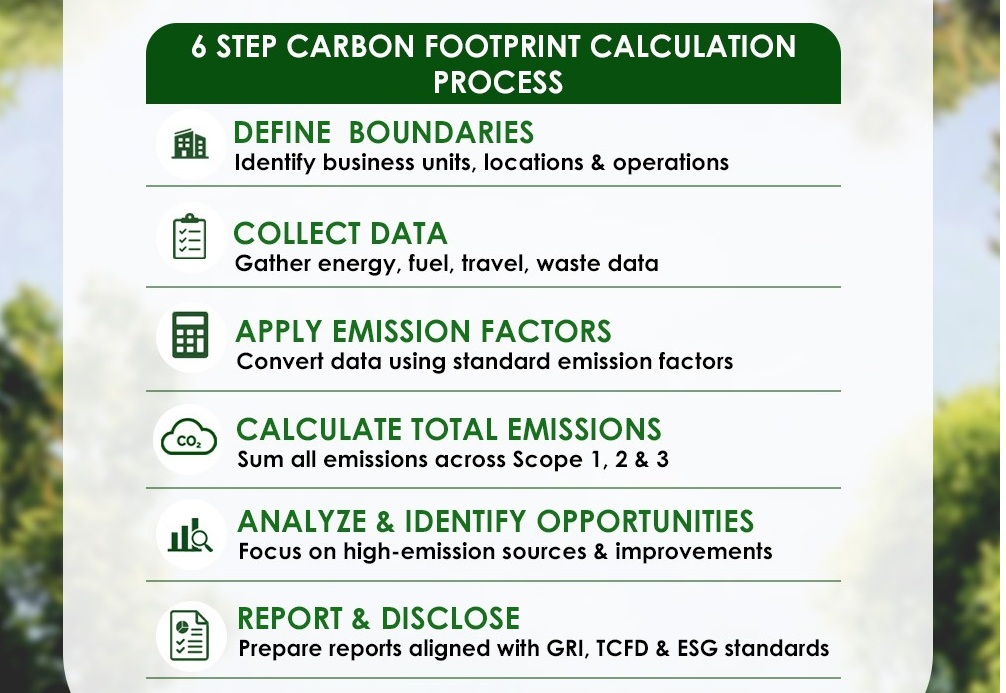
Step-by-Step Carbon Footprint Calculation
Step 1: Define Organizational Boundaries
Identify:
• Business units
• Locations
• Boundary conditions
👉 This ensures accurate and consistent reporting.
Step 2: Collect Activity Data
Gather data such as:
• Electricity bills
• Fuel consumption
• Travel records
• Waste data
Step 3: Apply Emission Factors
Convert activity data into emissions using standard emission factors.
Step 4: Calculate Total Emissions
Sum all emissions across:
• Scope 1
• Scope 2
• Scope 3
Step 5: Analyze & Identify Reduction Opportunities
Focus on:
• High-emission sources
• Inefficient processes
Step 6: Report & Disclose
Prepare reports aligned with:
• GRI
• TCFD
• ESG reporting standards
How to Reduce Carbon Emissions
✔ Improve Energy Efficiency
✔ Switch to Renewable Energy
✔ Optimize Supply Chain
✔ Reduce Waste
✔ Implement Carbon Management Systems
Frequently Asked Questions
Ready to Calculate Your Carbon Footprint?
Get expert support to measure, report, and reduce greenhouse gas emissions.
Book a Free Consultation