

Why the UAE Logistical and Industrial Sector Needs Aggressive EHS and ESG Alignment
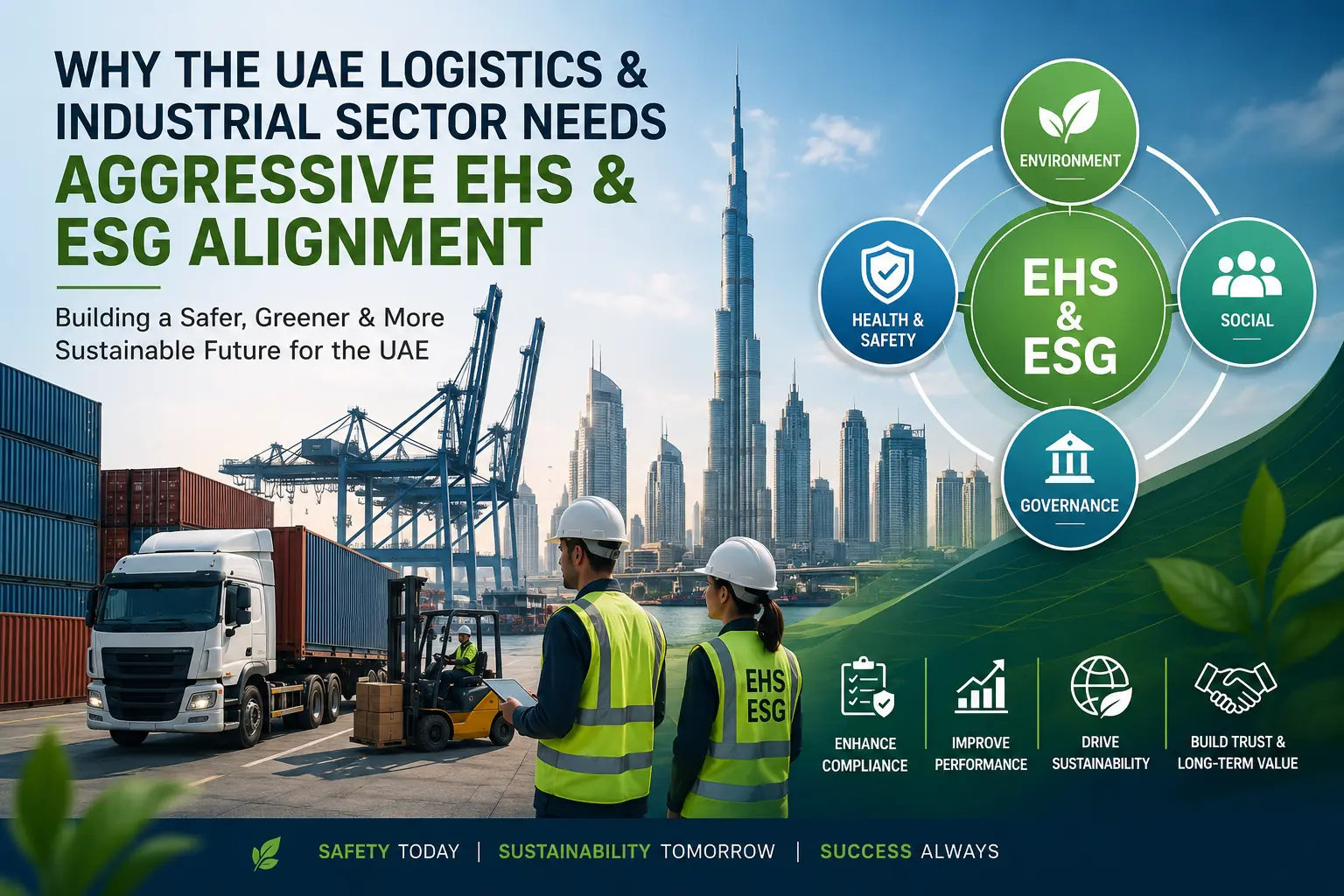
The UAE’s industrial and logistics sectors are experiencing an unprecedented period of growth, driven by the National Strategy for Industry and Advanced Technology (Operation 300bn) and Dubai’s D300 economic agenda. However, this expansion coincides with a fundamental regulatory shift: sustainability is no longer a corporate choice; it is a legal mandate.
With the enforcement of Federal Decree-Law No. (11) of 2024 on the Reduction of Climate Change Effects, the UAE has established a binding framework for climate action. For high impact sectors like logistics, manufacturing, and industrial operations, navigating this era requires an aggressive convergence of traditional Environmental Health and Safety (EHS) systems with modern Environmental, Social, and Governance (ESG) data management.
The EHS vs. ESG Evolution
For decades, industrial entities in JAFZA, KIZAD, and DIC have relied on traditional EHS frameworks to manage floor-level risks—focusing on waste disposal, localized pollution, and worker safety.
Modern ESG, conversely, looks at enterprise-level risk, corporate governance, and carbon accounting. To avoid fragmented data and regulatory penalties, companies must treat EHS as the operational engine that feeds the ESG reporting framework.
The Driving Catalysts for Industrial Alignment in the UAE
1. Hard Regulatory Penalties under Federal Decree-Law No. 11 of 2024
The legislative landscape in the UAE shifted permanently with the enactment of the new Climate Change Law. All public and private entities—including those operating within Free Zones—must accurately measure, track, and verify their Greenhouse Gas (GHG) emissions through the Ministry of Climate Change and Environment (MOCCAE) platform.
The Cost of Non-Compliance: Industrial operations that fail to submit their annual emissions inventory or maintain audit-ready records for at least five years face severe administrative fines ranging from AED 50,000 to AED 2,000,000.
The Escalation Mechanism: Repeat offenses within a two-year window trigger a doubling rule, raising financial exposure up to AED 4,000,000, alongside potential permit suspensions.
2. Commercial Incentives: Monetizing Data Through Green ICV
Industrial compliance is not just about avoiding penalties; it directly impacts your bottom line via the National In-Country Value (ICV) Program. The Ministry of Industry and Advanced Technology (MoIAT) rewards sustainable operations through Green ICV criteria.
By demonstrating quantifiable efforts in circular economy practices, water recycling, and emissions reduction, manufacturing and logistics firms can achieve up to a 3% bonus on their overall ICV score. In a hyper-competitive local procurement landscape, this bonus can be the deciding factor in winning multi-million dirham government tenders.
3. Supply Chain Pressure and Scope 3 Trajectories
Global logistics hubs and multinational manufacturing partners operating out of Dubai are increasingly scrutinized on their Scope 3 (supply chain) emissions. Large-scale entities emitting over 0.5 million metric tons of $CO_2e$ annually are already legally mandated to register with the UAE National Register for Carbon Credits. If your industrial business acts as a vendor or logistics provider to these tier-1 corporations, a lack of transparent ESG data will lead to commercial exclusion.
Mapping the Crossover: Turning EHS Metrics into ESG Disclosures
The most efficient way to build an industrial ESG strategy is to leverage data that your operations team is likely already tracking under traditional EHS monitoring.
| Traditional EHS Data Point | Modern ESG Conversion / Disclosure |
|---|---|
| Fuel consumption logs & generator run-times | Quantifiable Scope 1 Emissions (CO₂e) for mandatory MOCCAE reporting |
| Utility bills & warehouse electricity usage | Scope 2 Emissions tracking and renewable energy transition data |
| On-site incident rates & OHSAS/ISO 45001 logs | Social (S) Disclosures regarding labor rights, workplace safety, and welfare |
| Hazardous waste manifests & effluent testing | Environmental (E) Metrics covering circularity, waste diversion, and water stewardship |
Actionable Strategy: Bridging the Gap for Industrial Leaders
To achieve aggressive alignment and ensure your operations are fully compliant with evolving
regional guidelines, corporate leaders should adopt a structured phased approach:
• Establish Cross-Functional Climate Governance: Move ESG out of marketing or
corporate communications. Form a dedicated climate committee that unites your EHS
operational managers with your Chief Financial Officer (CFO) and compliance officers.
• Deploy Automated ESG Data Infrastructure: Manual, spreadsheet-based data tracking is highly prone to human error and fails to meet the strict auditing standards required by local authorities. Shift toward digital platforms that offer traceable activity data directly linked to facility logs and system extracts.
• Execute a Rigorous ESG Gap Analysis: Industrial sectors should actively benchmark their current health, safety, and environmental practices against international frameworks (like GRI and TCFD) alongside local mandates (such as the DFM/ADX ESG disclosure guides).
Secure Your Compliance Advantage
The convergence of EHS and ESG is transforming how industrial and logistics firms operate in the Middle East. Transitioning from defensive compliance to proactive sustainability management safeguards your business against escalating regulatory risks while unlocking tangible financial rewards.
Unsure if your operations meet the latest federal mandates?
As a premier provider of EHS consulting in Dubai, the team at ESG Consultants possesses over 15 years of regional experience helping industrial enterprises navigate environmental compliance, optimize carbon accounting, and build defensible ESG strategies.
Contact our Dubai-based advisory team today to schedule your comprehensive ESG Gap Analysis.
Need Specialized Assistance?
Navigating the intersection of industrial EHS and shifting federal ESG laws requires expert guidance. Get in touch with ESG Consultants Dubai to ensure your logistical or manufacturing operations are fully compliant, audit-ready, and commercially optimized.
Frequently Asked Questions
Book Your FREE ESG Readiness Assessment Today.
Contact Information
Website: https://www.esgconsultants.ae
Email: info@esgconsultants.ae
Phone: +971 52 416 9197