

GHG MRV in the UAE: Monitoring, Reporting and Verification Explained
Introduction
Greenhouse gas emissions management is becoming increasingly important for businesses operating in the UAE. As the country advances its climate and Net Zero objectives, organizations need reliable systems to measure, report and verify greenhouse gas emissions.
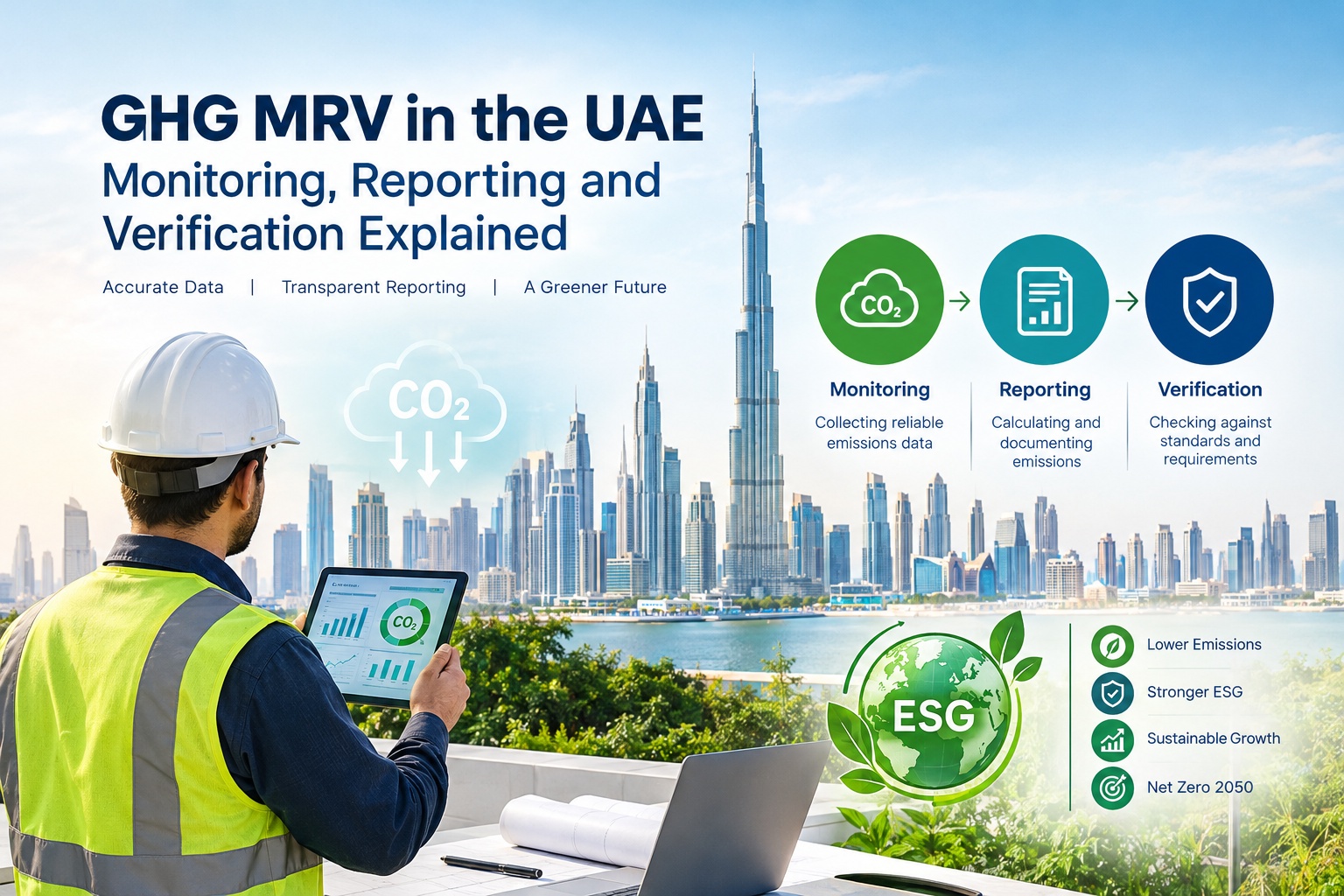
GHG MRV—Monitoring, Reporting and Verification—provides a structured framework for collecting emissions data, calculating GHG emissions, preparing reports and improving the reliability of reported information.
Federal Decree-Law No. 11 of 2024 establishes requirements for designated emission sources relating to regular emissions measurement, emissions inventories, periodic reporting and record keeping.
What Is GHG MRV?
GHG MRV stands for Greenhouse Gas Monitoring, Reporting and Verification.
It consists of three key stages:
✅ Monitoring: Collecting reliable activity and emissions data.
✅ Reporting: Calculating and documenting greenhouse gas emissions.
✅ Verification: Checking reported information against applicable requirements and methodologies.
A robust MRV system helps organizations create accurate, traceable and consistent emissions data.
Why Is GHG MRV Important in the UAE?
The UAE has established ambitious climate objectives, including its Net Zero by 2050 Strategy. Reliable emissions data is essential for measuring progress and identifying opportunities for emissions reduction.
Effective GHG MRV can help businesses:
✅ Improve emissions data accuracy
✅ Support regulatory reporting
✅ Strengthen ESG disclosures
✅ Identify major emission sources
✅ Develop carbon reduction strategies
✅ Prepare for verification
✅ Track progress toward Net Zero targets
The UAE also launched a National Measurement, Reporting and Verification (MRV) System in 2025 to strengthen emissions and environmental data management.
Understanding Scope 1, Scope 2 and Scope 3
Scope 1 – Direct Emissions
Emissions from sources owned or controlled by an organization, such as:
✅ Company vehicles
✅ Diesel generators
✅ Boilers
✅ Industrial processes
✅ Refrigerant leakage
Scope 2 – Purchased Energy
Indirect emissions associated with purchased energy, primarily:
✅ Electricity
✅ Purchased heating or cooling where applicable
Scope 3 – Value Chain Emissions
Other indirect emissions throughout the organization's value chain, including:
✅ Purchased goods and services
✅ Business travel
✅ Employee commuting
✅ Waste
✅ Transportation
✅ Supply-chain activities
Understanding these three scopes is an important part of GHG accounting in the UAE.
GHG Accounting vs GHG MRV
GHG accounting focuses on calculating an organization's greenhouse gas emissions.
GHG MRV covers the wider process of collecting, calculating, documenting, reporting and verifying emissions information.
In simple terms:
GHG Accounting = How much do we emit?
GHG MRV = How do we measure, document, report and demonstrate the reliability of those emissions figures?
How Does the GHG MRV Process Work?
A practical GHG MRV process generally includes:
1. Define the Boundary
Identify the entities, facilities and operations included in the inventory.
2. Identify Emission Sources
Map relevant Scope 1, Scope 2 and Scope 3 sources.
3. Collect Data
Gather activity data from finance, facilities, procurement, operations and other departments.
4. Calculate Emissions
Apply appropriate emission factors and calculate emissions in tonnes of CO₂ equivalent (tCO₂e).
5. Quality Check
Review data, calculations, units, assumptions and supporting documents.
6. Prepare the Report
Document methodology, boundaries, emissions, exclusions and assumptions.
7. Verify Where Applicable
Assess the reported information against the relevant requirements or verification criteria.
8. Use the Results
Identify emission hotspots and develop reduction and decarbonization strategies.
Common GHG Reporting Challenges
UAE organizations may face challenges such as:
✅ Data spread across different departments
✅ Missing utility or fuel records
✅ Manual spreadsheet calculations
✅ Inconsistent emission factors
✅ Limited Scope 3 information
✅ Poor documentation
✅ Difficulty maintaining historical records
A centralized GHG accounting and MRV system can help address these challenges.
How Technology Supports GHG MRV
Digital GHG accounting platforms can simplify emissions data management by providing:
✅ Centralized data collection
✅ Scope 1, 2 and 3 tracking
✅ Automated calculations
✅ Emission-factor management
✅ Supporting-document storage
✅ Data validation
✅ QA/QC controls
✅ Dashboards
✅ Emissions reporting
✅ Audit-ready records
ESG Consultants UAE provides GHG accounting and MRV solutions designed to help organizations manage emissions data, calculations, documentation and reporting through a centralized system.
GHG MRV and ESG Reporting
Accurate GHG data is an important component of ESG and sustainability reporting.
A reliable emissions inventory can support:
✅ ESG reports
✅ Sustainability disclosures
✅ Carbon reduction targets
✅ Net Zero strategies
✅ Climate-risk assessments
✅ Decarbonization planning
Organizations should ensure that the emissions figures used in their ESG reports can be traced back to their underlying GHG inventory and supporting data.
How GHG MRV Supports Net Zero
MRV provides the measurement foundation for a company's decarbonization journey:
Measure → Understand → Set Targets → Reduce → Monitor → Report → Verify → Improve
Without reliable baseline data, businesses cannot effectively measure whether their carbon-reduction initiatives are delivering results.
GHG MRV Checklist for UAE Businesses
Businesses preparing for GHG reporting should consider whether they have:
✅ Defined organizational boundaries
✅ Identified Scope 1, 2 and relevant Scope 3 emissions
✅ Assigned responsibility for emissions data
✅ Collected electricity and fuel records
✅ Documented emission factors
✅ Established calculation methodologies
✅ Implemented data-quality checks
✅ Maintained supporting evidence
✅ Prepared a GHG inventory
✅ Assessed verification requirements
✅ Established a process for ongoing reporting
How ESG Consultants UAE Can Help
Managing GHG emissions requires more than simply calculating a carbon footprint. Organizations need a structured approach to data collection, GHG accounting, reporting, verification and continuous improvement.
ESG Consultants UAE supports businesses with:
✅ GHG Accounting
✅ GHG MRV
✅ Carbon Footprint Assessment
✅ GHG Emissions Reporting
✅ ESG Reporting
✅ Net Zero Strategy
✅ Decarbonization Planning
✅ ESG Compliance Advisory
With specialist expertise and digital GHG accounting solutions, businesses can build a more reliable emissions management process and strengthen their readiness for evolving climate and ESG requirements.
Conclusion
GHG MRV in the UAE is becoming an important part of effective climate and ESG management.
By establishing reliable systems for monitoring, reporting and verification, organizations can improve emissions data quality, strengthen ESG reporting, identify carbon-reduction opportunities and support their long-term Net Zero journey.
For UAE businesses, the process starts with a clear approach:
Measure your emissions → calculate your GHG inventory → validate your data → report accurately → verify where applicable → reduce emissions.
A well-designed GHG MRV system can turn emissions data from a reporting requirement into a practical tool for better environmental and business decision-making.
Frequently Asked Questions (FAQ)
GHG MRV means Greenhouse Gas Monitoring, Reporting and Verification. It provides a structured process for measuring, reporting and checking greenhouse gas emissions.
GHG accounting is the process of calculating an organization's greenhouse gas emissions, normally reported in tonnes of CO₂ equivalent.
Scope 1 covers direct emissions, Scope 2 covers purchased energy emissions, and Scope 3 covers other indirect value-chain emissions.
GHG reporting helps organizations understand their emissions, support applicable regulatory requirements, improve ESG disclosures and develop effective carbon-reduction strategies.
Yes. Digital GHG accounting platforms can support data collection, calculations, emission-factor management, reporting, documentation and data-quality controls.
Companies should define their reporting boundary, identify emission sources, collect reliable activity data, document calculation methodologies, establish quality controls and maintain supporting evidence.
Need Support with GHG MRV in the UAE?
Contact ESG Consultants UAE to discuss GHG accounting, emissions reporting, verification readiness and your organization's Net Zero goals.
Website: esgconsultants.ae
Phone / WhatsApp: +971 52 416 9197
Book Your FREE ESG Readiness Assessment Today.
Contact Information
Website: https://www.esgconsultants.ae
Email: info@esgconsultants.ae
Phone: +971 52 416 9197