

What Are Carbon Credits? A Complete Guide to Carbon Credits, Benefits, and Business Value
What Are Carbon Credits? Everything Businesses Need to Know
Climate change has become one of the most pressing global challenges, pushing governments and businesses to reduce greenhouse gas emissions. While organizations continue working to lower their carbon footprint, some emissions are difficult or impossible to eliminate immediately. This is where carbon credits play an important role.
Carbon credits are an effective climate finance tool that enables organizations to support verified emission reduction projects while progressing toward their sustainability and ESG objectives.
What Is a Carbon Credit?
A carbon credit represents one metric tone (1 tCO₂e) of carbon dioxide (CO₂), or its equivalent greenhouse gases, that has been:
• Reduced
• Removed
• Avoided
from entering the atmosphere through a certified environmental project.
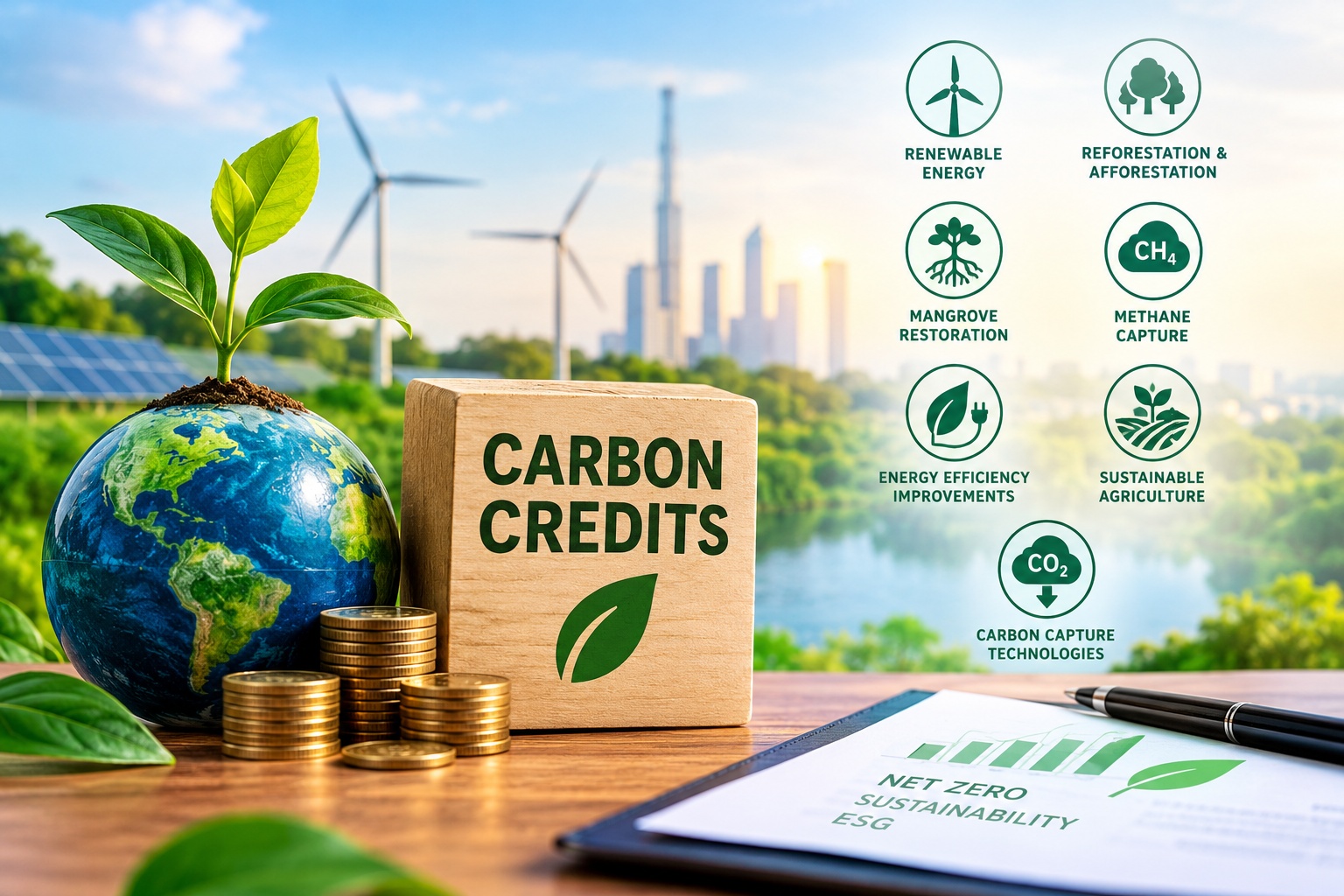
These credits are generated through projects such as:
✅ Renewable energy
✅ Reforestation and afforestation
✅ Mangrove restoration
✅ Methane capture
✅ Energy efficiency improvements
✅ Sustainable agriculture
✅ Carbon capture technologies
Once verified by internationally recognized standards, these credits can be purchased by organizations to offset emissions that cannot yet be eliminated.
How Do Carbon Credits Work?
The carbon credit process typically follows these steps:
1. A Climate Project Reduces Emissions
A renewable energy or conservation project prevents or removes greenhouse gas emissions.
2. Independent Verification
An accredited third party verifies the project's environmental impact.
3. Carbon Credits Are Issued
Verified reductions are converted into tradable carbon credits.
4. Organizations Purchase Credits
Businesses buy credits to compensate for unavoidable emissions while continuing to reduce their operational footprint.
Why Do Companies Buy Carbon Credits?
Organizations purchase carbon credits for several strategic reasons.
✦ Meet Net Zero Commitments
Many companies have pledged to achieve Net Zero emissions. Carbon credits help address residual emissions while long-term decarbonization plans are implemented.
✦ Address Unavoidable Emissions
Certain industries, including aviation, construction, manufacturing, shipping, and heavy industry, cannot eliminate all emissions immediately.
Carbon credits help bridge this gap.
✦ Regulatory Compliance
Many countries and regions have environmental regulations or carbon pricing mechanisms requiring organizations to manage emissions effectively.
✦ Improve ESG Performance
Investors increasingly evaluate companies based on Environmental, Social, and Governance (ESG) performance.
Supporting verified carbon projects demonstrates environmental responsibility and strengthens ESG reporting.
✦ Support Global Climate Action
Purchasing quality carbon credits finances projects that:
✅ Protect forests
✅ Develop renewable energy
✅ Improve biodiversity
✅ Create local employment
✅ Support sustainable communities
What Makes a High-Quality Carbon Project?
Not all carbon credits are created equal. High-quality carbon projects share several important characteristics.
Additional
The project would not have happened without carbon finance.
Measurable
Emission reductions are scientifically calculated and accurately monitored.
Permanent
The environmental benefits are designed to last for many years.
Transparent
Projects undergo independent third-party validation and verification.
Sustainable
Quality projects provide environmental, social, and economic benefits for local communities while protecting ecosystems.
Common Myths About Carbon Credits
Myth 1: Carbon Credits Allow Companies to Pollute
Reality:
Carbon credits are not a replacement for emission reductions.
Responsible organizations first reduce emissions within their operations and use carbon credits only for unavoidable emissions.
Myth 2: All Carbon Credits Are the Same
Reality:
Carbon credits vary significantly in quality depending on:
✅ Project type
✅ Verification standards
✅ Monitoring methods
✅ Environmental integrity
✅ Social impact
High-quality credits provide measurable, verified climate benefits.
Myth 3: Carbon Credits Don't Create Real Impact
Reality:
Certified carbon projects have delivered millions of tones of verified emission reductions while supporting biodiversity, renewable energy, and sustainable development worldwide.
Benefits of Carbon Credits
Organizations using high-quality carbon credits can benefit from:
✅ Accelerating Net Zero strategies
✅ Supporting ESG initiatives
✅ Demonstrating climate leadership
✅ Enhancing corporate reputation
✅ Meeting stakeholder expectations
✅ Supporting global sustainability projects
✅ Creating positive environmental and social impact
Carbon Credits vs Carbon Offsets
Although often used interchangeably, there is a slight distinction.
| Carbon Credit | Carbon Offset |
|---|---|
| A verified tradable unit representing one tonne of CO₂ reduced or removed | The act of compensating for emissions by purchasing carbon credits |
| Generated by certified climate projects | Used by organizations to balance unavoidable emissions |
The Future of Carbon Credits
As governments strengthen climate policies and businesses increase ESG commitments, demand for credible carbon credits continues to grow.
Organizations are expected to place greater emphasis on:
✅ Nature-based solutions
✅ Renewable energy investments
✅ Carbon removal technologies
✅ Transparent ESG reporting
✅ High-integrity carbon markets
Quality, transparency, and measurable impact will become increasingly important when selecting carbon projects.
UAE National Register for Carbon Credits: A Step towards Climate Neutrality
The UAE has strengthened its climate action framework through Cabinet Resolution No. 67 of 2024, which establishes the National Register for Carbon Credits. The Resolution aims to regulate carbon-credit registration, support greenhouse-gas reduction and contribute to the UAE’s goal of achieving climate neutrality by 2050. The Resolution applies to public and private entities whose annual Scope 1 and Scope 2 emissions reach or exceed 500,000 metric tones of CO₂ equivalent. Organizations below this threshold may also participate voluntarily to register, obtain and trade approved carbon credits.
Covered entities must establish a reliable monitoring, reporting and verification system. Greenhouse-gas emissions must be calculated using recognized methodologies, reported annually to the Ministry and competent authority, and verified by authorized and appropriately accredited verification agencies.
The National Register will record the issuance, ownership, transfer and retirement of carbon credits. Approved credits may be traded through regulated platforms, while organizations purchasing credits may use them to compensate for emissions and support their climate-neutrality objectives.
For UAE businesses, the Resolution highlights the growing importance of maintaining accurate greenhouse-gas inventories, setting emission-reduction plans, obtaining independent verification and ensuring that carbon claims are transparent, measurable and free from double counting. Early preparation will help organizations improve compliance, strengthen sustainability performance and access future carbon-market opportunities.
Final Thoughts
Carbon credits are much more than financial instruments—they are investments in a more sustainable future. When combined with meaningful emission reduction efforts, they enable organizations to contribute to global climate action while achieving business and sustainability goals.
Businesses should always prioritize reducing their direct emissions first, then use high-quality, independently verified carbon credits to address emissions that cannot yet be eliminated. This balanced approach supports both environmental responsibility and long-term ESG success.
Partner with ESG Consultants UAE for Your Carbon Management Journey
Understanding carbon credits is only one part of a successful climate strategy. Organizations must first measure and reduce their greenhouse gas (GHG) emissions before using high-quality carbon credits to address unavoidable emissions. This aligns with internationally recognized best practices and evolving UAE sustainability requirements.
At ESG Consultants UAE, we help organizations build credible, data-driven decarbonization strategies through comprehensive sustainability and carbon management services, including:
✅ Carbon Footprint Assessment & GHG Accounting
✅ ESG Reporting (GRI, SASB, IFRS & UAE requirements)
✅ Decarbonization & Net Zero Strategy Development
✅ Science-Based Targets (SBTi) Advisory
✅ Carbon Offset & Carbon Credit Strategy
✅ Climate Risk Assessment
✅ Sustainability Roadmap Development
✅ Environmental Compliance Advisory
✅ ESG Training & Capacity Building
Our team works with businesses across the UAE to develop practical sustainability solutions that improve ESG performance, support regulatory compliance, and create long-term business value.
Ready to accelerate your sustainability journey? Contact ESG Consultants UAE to discuss your carbon management, ESG reporting, and Net Zero goals with our sustainability experts.
Frequently Asked Questions (FAQ)
A carbon credit represents one metric tonne of carbon dioxide (CO₂) reduced, removed, or prevented from entering the atmosphere through a verified project.
Businesses buy carbon credits to offset unavoidable emissions, achieve Net Zero goals, comply with regulations, and strengthen ESG performance.
Carbon credits are the verified units generated by climate projects, while carbon offsetting is the process of using those credits to compensate for emissions.
Trustworthy carbon credits come from projects that are additional, measurable, permanent, transparent, and independently verified.
No. Carbon credits should complement—not replace—direct efforts to reduce greenhouse gas emissions.
Have More Questions About Carbon Credits?
Speak directly with our team of sustainability and carbon management experts in the UAE:
Call / WhatsApp: +971 524169197
Website: esgconsultants.ae
Book Your FREE ESG Readiness Assessment Today.
Contact Information
Website: https://www.esgconsultants.ae
Email: info@esgconsultants.ae
Phone: +971 52 416 9197